
Placentia Previous Residents by Era
Different sources answer different parts of a Placentia house history. The deed index follows recorded parties and documents. Directories and census schedules provide dated household evidence. Permits place physical changes on a timeline, while probate and obituaries can explain what happened after a resident died or transferred an interest. The coverage table keeps those trails separate.
| Source | Years It Covers | Where Held | What It Shows |
|---|---|---|---|
| RecorderWorks electronic index | January 4, 1982 to present | Orange County RecorderWorks | Indexed parties, types, dates, numbers, APN, and legal description |
| Orange County Archives property indexes | 1889 to 1953 | Orange County Archives | Historic grantor and grantee finding aid |
| Documented deed volumes | 1889 to 1926 | Orange County Archives and Clerk-Recorder copy channels | Original deed references and pages |
| County directories including Placentia | 1926, 1929, 1931 | NARA inventory, library, or archive consultation | Dated address and household lines |
| Federal census | Public through 1950 in 2026 | NARA and library databases | Households at an enumeration date |
| City permits | Current SmartGov; legacy start unpublished | Placentia city channels | Project address, applicant, work, and inspection chronology |
| Probate index and files | 1889 to present | Orange County Superior Court | Estates, heirs, fiduciaries, and property filings |
Use the current parcel and deed trail for ownership questions, then add dated occupancy sources. The local research confirms only three directory years, and the latest public federal census in 2026 is 1950. A blank year can mean a missed canvass, a changed surname, a separate Atwood heading, or a real move.
The Orange County Archives holdings page shows the breadth of the historic shelf used for previous residents research.
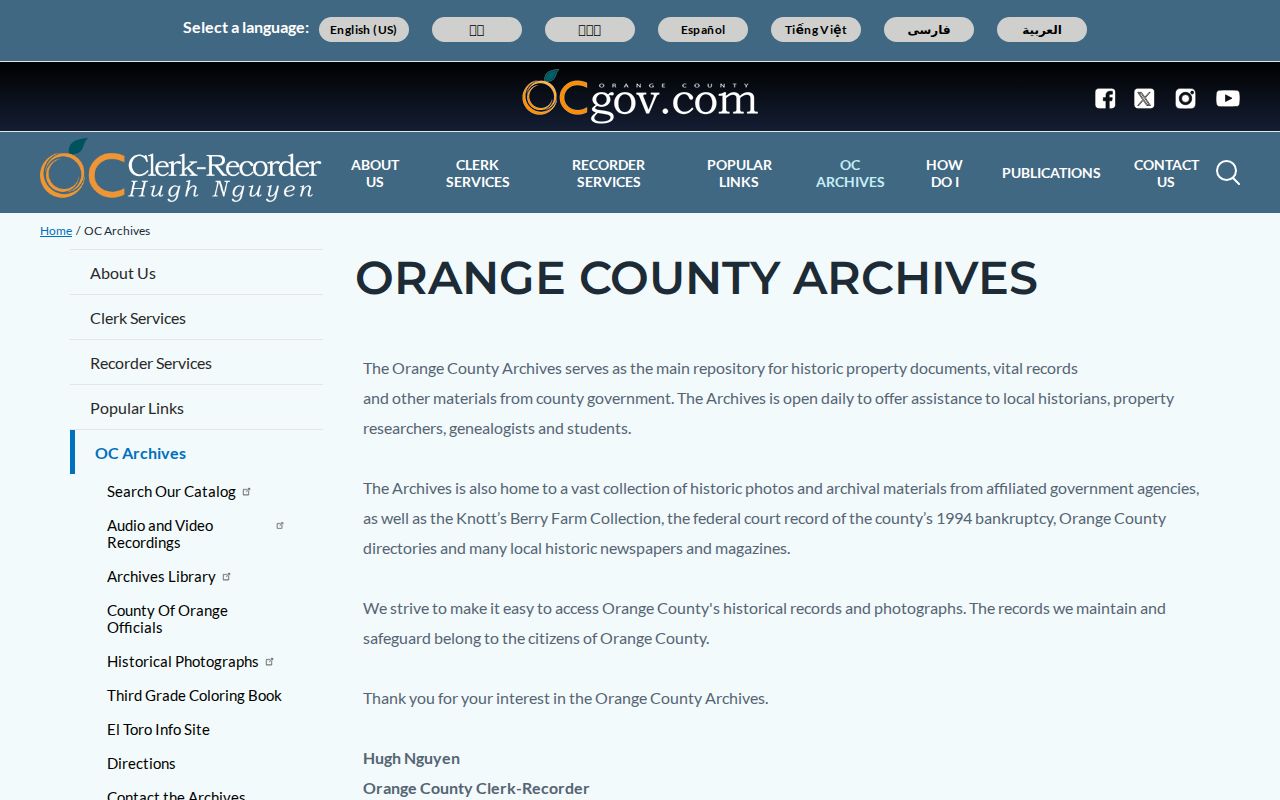
Archives material can connect deeds, directories, newspapers, photographs, and vital records, but each item still needs its own date and citation.
Walk a Placentia Deed Chain Backward
A current address enters the property trail through the Treasurer tax search or OC Tax Map. That bridge supplies an APN and parcel geometry. The APN then guides RecorderWorks, where a researcher can inspect indexed conveyance parties and legal-description paths. The free assessor endpoint is not an owner-name directory, so do not begin by trying to type a person into that box.
- Record the situs address, APN, subdivision, lot and block, legal description, and the date of the lookup.
- In RecorderWorks, search the APN and filter for DEED, GRANT DEED, QUITCLAIM DEED, or TRUSTEES DEED. Do not treat a TRUST DEED, reconveyance, or substitution of trustee as a new owner transfer.
- Capture the document number, recording date, type, grantor, grantee, and legal description. Retrieve the actual copy when the legal description is needed.
- Search the current grantee as a prior grantee, then pivot to that party’s grantor. Validate each same-name hit with APN, lot, block, legal description, and chronology.
- When the electronic years end, move to the historical index books, fiche, book and page references, and Archives holdings. Do not claim a continuous online run through an unverified seam.
- Grantor and grantee
- The grantor gives or transfers an interest; the grantee receives it. The labels describe a document role, not a statement that someone lived at the address.
- Chain of title
- A linked sequence of recorded transfers for one parcel or legal description.
- Legal description
- The formal land description, such as lot, block, subdivision, or survey reference. It can bridge an old address when street wording changes.
The Orange County copy instructions explain the next step after an index result. The source capture below is a reminder that a known reference is needed for a copy request.
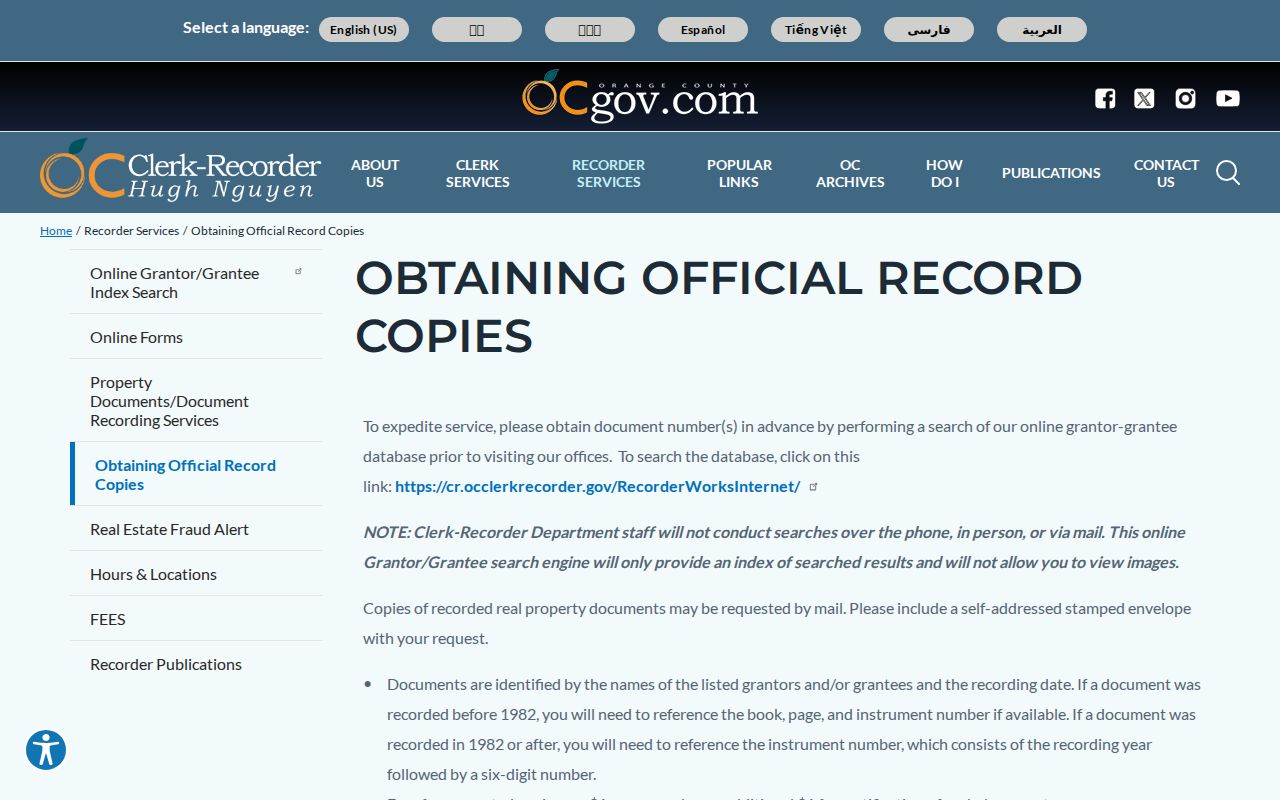
RecorderWorks supplies the index reference. The counter or mail channel supplies a copy when the requester provides the document number or older book, page, and instrument details.
Crossing Placentia's 1953 to 1981 Index Seam
Orange County Archives documents property indexes from 1889 through 1953, while ordinary RecorderWorks electronic coverage begins January 4, 1982. RecorderWorks advertises historical index-book and fiche controls, but the exact earliest and continuous years were not stated. That makes 1953 to 1981 a genuine research seam for previous residents, not a period that can be filled by assumption.
For the seam, preserve every known name, approximate year, legal description, subdivision, lot or block, and prior book or page reference. Ask the Clerk-Recorder or Archives where the 1954 to 1981 grantor-grantee indexes and document images are accessed. The Archives reference channel is archives@rec.ocgov.com or (714) 834-2536. The recorded-document procedural line is (714) 834-2500, but staff do not perform substantive name research by phone, mail, or counter.
This boundary is also why the index should not be confused with a free deed-image viewer. An index hit can point to the next source even when the image is not online.
Placentia's 1889 to 1953 Archive Trail
Orange County Archives is the regional fallback for previous residents before the clean electronic seam. The documented property-index run covers 1889 to 1953, and deed volumes from 1889 to 1926 are documented as original material. The archive’s emphasis is on records before 1960, but that routing note does not prove that every title ends in 1960. Request the exact year, title, publisher, index type, and whether an item contains alphabetical, street, business, or locality sections.
Researchers can visit Room 108 at 211 W. Santa Ana Boulevard, Monday through Friday from 9 a.m. to noon and 1 p.m. to 4:30 p.m. The noon to 1 p.m. closure matters when planning a record session. Older deeds move from an index reference to a book or copy channel. The Archives contact record shows the reference route for a name, approximate year, property description, and any book or page citation.
The archive contact capture reinforces the need to send a focused request with a parcel or document clue.
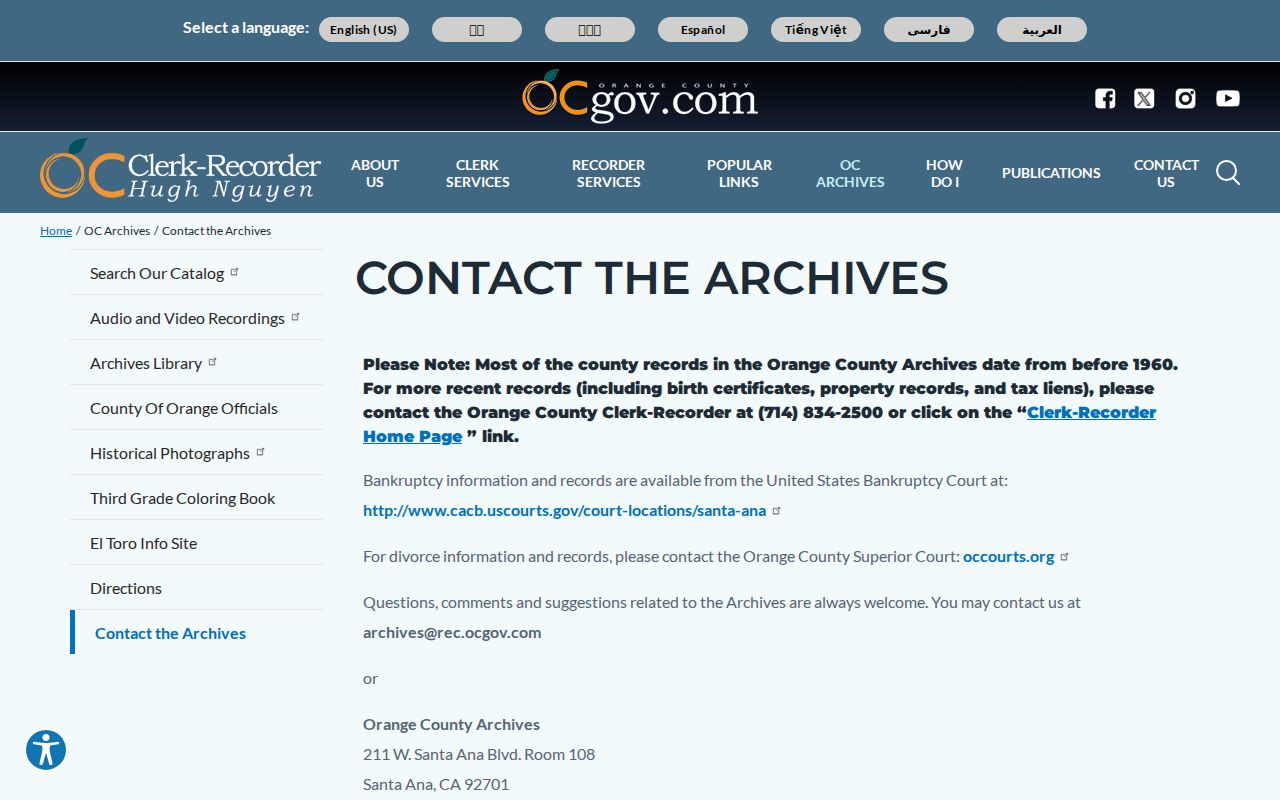
A focused request can identify the right holding without asking staff to build an unsupported merged list of residents.
Placentia's Verified Directories Meet the Census
NARA’s circa-1930 inventory verifies Orange County directories that include Placentia in 1926, 1929, and 1931. NARA lists Atwood separately, so search both locality headings. Publisher details are not identified on the inventory page. The California State Library’s Orange County workflow says to search the city-directory database by county first, then repeat with the city name, and to try the same two-pass method in telephone books.
Pair the 1929 directory with the public 1930 census, while remembering that a directory reflects a publisher’s canvass and the census reflects an enumeration date. Search the surname, given name or initials, then check address and household clues. The exact Placentia reverse or criss-cross run is not published, and no actual Placentia directory page was openly inspectable in the research pass. Do not invent a sample line. The broader collection trail and reading method are set out in the Placentia city directory collections.
The Placentia Library History Room at 411 E. Chapman Avenue holds local books, photographs, videos, oral histories, maps, and past PYLUSD yearbooks. General local-history material is available during library hours; special family and civic manuscripts require an appointment. Ask staff to confirm the directory, telephone-book, reverse-directory, newspaper, obituary-index, and yearbook runs before relying on a gap.
For a household overlay, log the locality heading, surname, given name or initials, spouse notation, residence address, page and column, volume title, year, publisher, and abbreviation key. A missing entry is a lead to test in the next year, address section, census, newspaper, photograph, or manuscript, not proof that the person was absent.
APN Bridges a Placentia Address History
Address wording can shift as parcels are divided, merged, annexed, or re-described. Preserve the APN, legal description, subdivision, lot and block, map reference, historical street names, and approximate dates in a parcel ledger. The current parcel record and the occupancy record should remain separate. A deed may show a transfer even when a different household used the property.
Orange County’s Treasurer search accepts street-address autocomplete, parcel number, and tax-default paths. The address must be selected from the drop-down when autocomplete is used. The OC Tax Map and OC Public Works Landbase add geometry and map context, while final tract and parcel maps arrive after recordation and the public GIS release is annual. Use those layers to explain a changed parcel, not to infer a person.
Condominium units, master parcels, corner parcels, flag lots, common areas, and vacant parcels can break a simple number sequence. A historical chain should cite the exact legal description and map instead of relying on a modern street number alone.
Placentia Permits Date Physical Change
Placentia SmartGov presents public notices, parcel search, and permit modules. Account access is required for some applications and inspection results, and Building and Safety remained in beta during the 2026 fee transition. A permit can show a project address, applicant role, contractor, work type, issue or final dates, valuation, and inspection chronology when those fields are in the record. A permit date does not establish a move date.
For older cards or files, the legacy SmartGov cutoff is unpublished. Submit a focused request for identifiable application, permit, correction, inspection, and certificate or final records by address and date range. Building and Safety directs missing-record questions to (714) 993-8124. The city’s public-record request channel can inspect an existing record without asking staff to create a new history.
Use permit chronology to explain a changed building or parcel. It is a physical-building layer beside, not a replacement for, the deed and dated occupancy layers.
Probate and Obituaries Close a Placentia Trail
When a deed names a trust, estate, or deceased party, Orange County probate is the official next source. An online search locates a case, but public terminals and the clerk’s counter can supply documents that remote access withholds. Pre-1985 probate files generally use microfiche or reel at Central Justice Center Records and Exhibits. Mail orders use Form L-3009 and should identify the case number, decedent, requested document, filing date if known, copy count, and certification request.
Probate petitions, notices, orders, and final distribution documents may identify fiduciaries, heirs, devisees, and addresses at filing. An obituary, cemetery entry, newspaper notice, photograph, or family manuscript adds life context, but it does not replace a probate order or deed. A probate address can age quickly, so it should be labeled as a dated filing fact.
The Orange County probate copy instructions are the source for the court’s copy path.
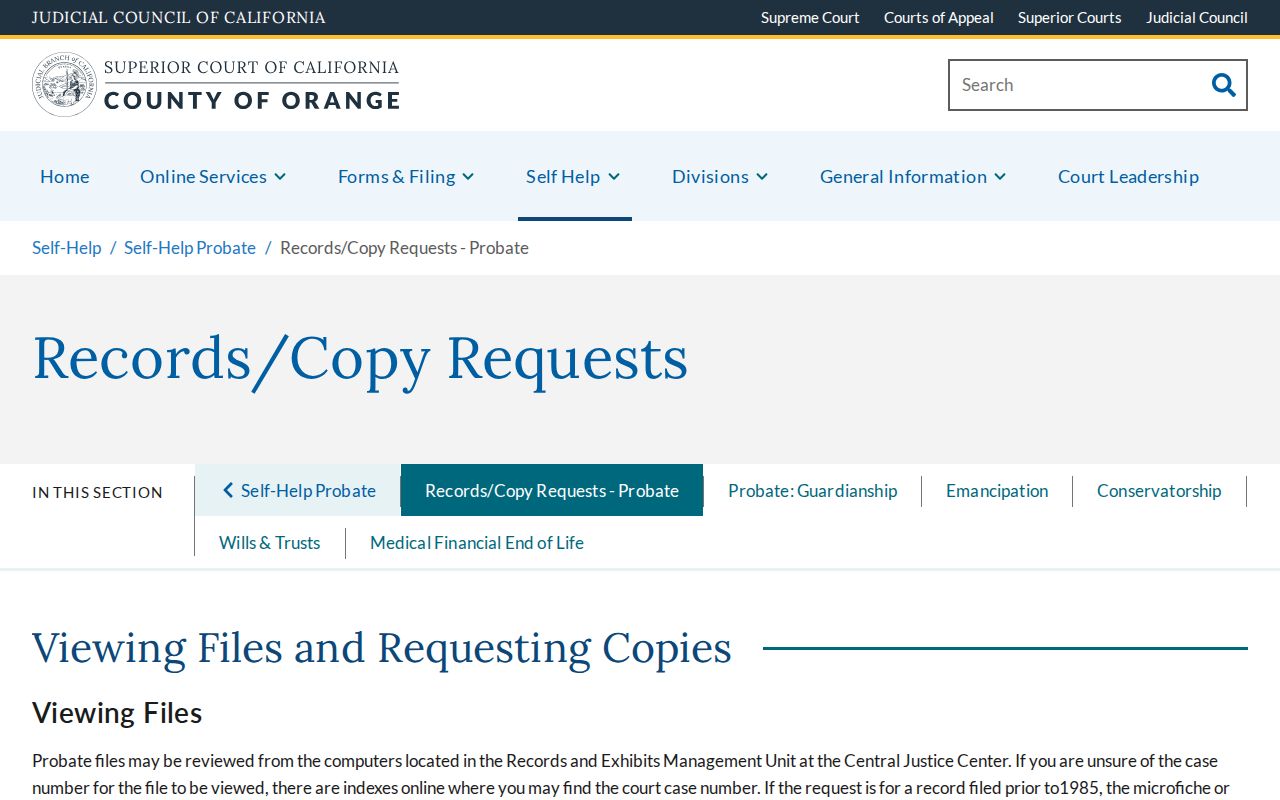
Probate can close an ownership trail or identify a family-history lead, but it cannot prove every relationship without the relevant order.
Past Households in a Placentia Address History
Previous residents are best reconstructed from a source-by-source ledger. The parcel ledger records APN, situs, legal description, subdivision, lot, block, map, and adjacent parcels. The deed ledger records dates, instruments, grantors, grantees, types, and legal-description matches. The occupancy ledger records source year, exact address, household name, role, and citation. A permit ledger records application number, applicant role, work, issue or final dates, and status.
Directory and census rows show a household at a historical moment. Deeds show recorded interests. Probate shows an estate process. Permits show physical work. These facts can overlap without being interchangeable. Pair 1926, 1929, and 1931 directory evidence with the 1930 census, then test the result against the parcel and newspaper trail.
Lawful use. Previous-resident research in Placentia is for house history, family history, and personal curiosity. Never use a dated record to track, threaten, harass, or approach a living person.
The research located no official Placentia-specific Sanborn edition, house-history guide, exact criss-cross run, permit-archive start date, or street-renumbering chronology. Those gaps stay in the ledger. Ask the library, Archives, Clerk-Recorder, or city custodian for the next documented source rather than turning an unverified lead into a fact.