
Start a Placentia Residents Directory Search
Name the fact before touching a keyboard. That single habit shapes any Placentia residents directory search. An address question goes first to the Orange County Treasurer-Tax Collector search and the parcel map. A title question takes the resulting APN into RecorderWorks. Registration questions belong to the Orange County Voter Lookup. Only the authenticated voter can pull an individual record there, though. A vanished household may instead need the History Room, the county archives, the federal census, and the three verified directory years. That trail matters more than any current roll.
Each record plays its own part. The assessor's free site reports annual value and exemption details once the APN is known, yet it suppresses owner names. A deed index lists indexed parties and recording history, not everyone at a property. City permits may add an applicant, a project address, or an inspection date. Court and vital records can confirm an event while still limiting copies. Treat each as a separate clue, and label its date, custodian, and access level.
- Define the question as a current address, recorded party, former household, civic record, or life event.
- For an address, use the Orange County Treasurer property search to select the street address and obtain the APN.
- Use the APN in the Orange County secured property search, then search RecorderWorks for deeds, liens, maps, and related indexed parties.
- For a person, compare the Orange County court index, permitted business or license records, and historical sources instead of treating one name hit as proof.
- When an existing record is not online, request it from the named custodian through its counter, mail, phone, archive, or California Public Records Act channel.
Keeping the sequence intact anchors every Placentia residents directory result to its creating source. It also stops a tax address, a mailing address, and a claimed residence from collapsing into one unsupported fact.
Placentia Resident Records Offices
Placentia runs no municipal recorder, no separate municipal court, and no local vital-record office. Orange County holds the deeds, certificates, parcels, court cases, probate, and restricted voter records. Placentia City Hall stays the local route for legislative files, permits, code material, and staff contacts. It also handles focused records requests. The offices listed here are starting points, not a single public roster.
Orange County Clerk-Recorder
601 N. Ross Street
Santa Ana, CA 92701
(714) 834-2500
RecorderWorks index
Orange County Assessor
500 S. Main Street, second floor
Orange, CA
(714) 834-2727
Orange County Registrar of Voters
1300 S. Grand Ave., Building C
Santa Ana, CA 92705
(714) 567-7600
Voter Lookup
The Clerk-Recorder counter hands over images and certifications. Staff will not run index research for you, though. Mail copies demand a known document number. An older book, page, or instrument reference also works. Include a self-addressed stamped envelope and payment to the county. The Assessor's Public Service Counter offers a separate channel. It is more current than the free APN search. At the city level, the City Clerk takes focused requests by web form, email, mail, or counter. Use this route whenever keyword browsing misses an existing file.
The Placentia City Clerk's published details list a counter schedule. It runs Monday through Thursday, 7:30 a.m. to 6 p.m., plus fax access. A response period never means staff will build a new resident list. Describe the record class, the date span, an address or APN, and the fields you want. View the Placentia City Clerk source page before relying on the local office details. Its records role is one part of the broader Placentia residents directory workflow.
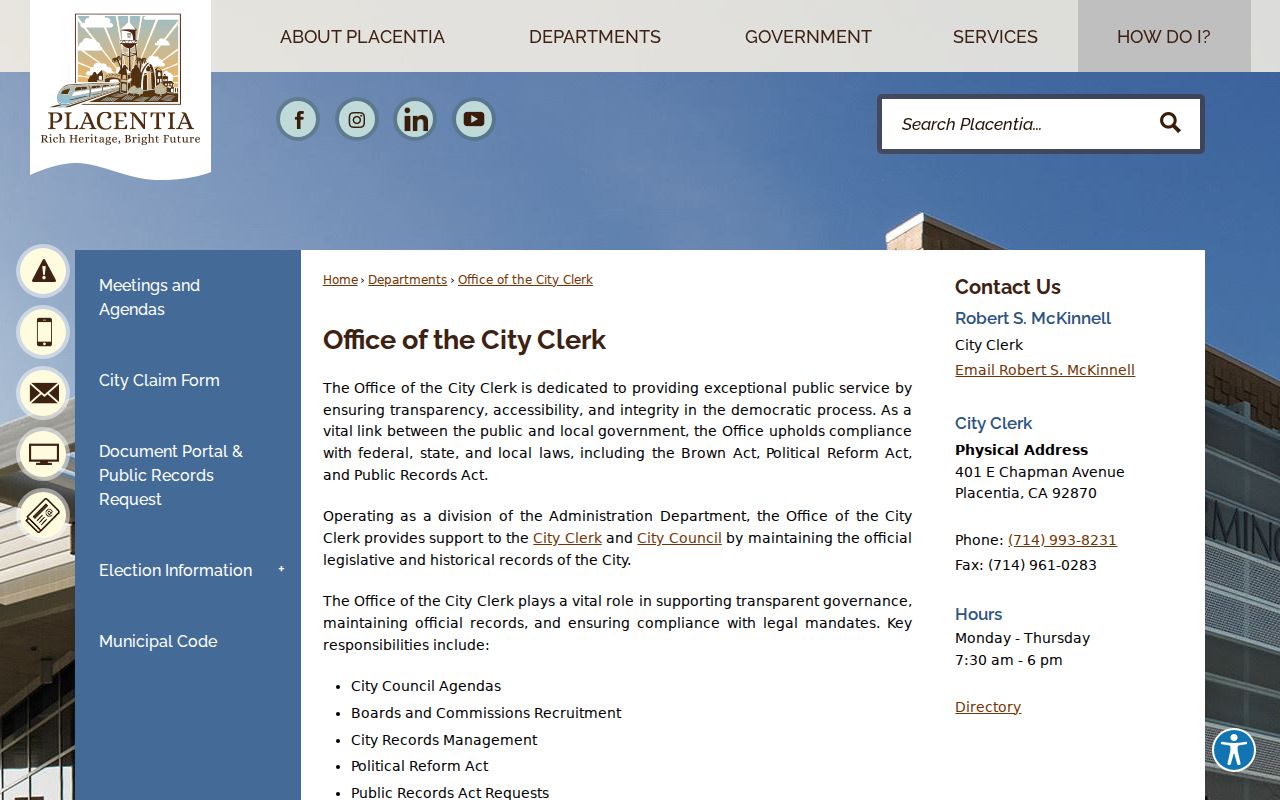
The image ties the local City Clerk channel to the wider Placentia residents directory workflow, where municipal files and county records answer different questions.
Current Placentia Resident Directory Sources
No current source adds up to one complete list of people. Each is a separate index with its own keys and limits. Property systems start from an address or APN. RecorderWorks starts from a name, APN, document number, legal description, or recording details. The voter tool starts from the voter's own credentials. A city staff directory surfaces public contacts, not residents.
| Source | Question it answers | Keeper | Access |
|---|---|---|---|
| Treasurer Tax Search | Which APN or tax path matches an address? | Orange County Treasurer-Tax Collector | Free web lookup |
| Secured value search | What annual value or exemption record follows an APN? | Orange County Assessor | Free APN-only site |
| RecorderWorks | Which indexed parties and documents connect to a parcel? | Orange County Clerk-Recorder | Free index; copies and images have fees |
| Voter Lookup | What is the authenticated voter's registration status? | Orange County Registrar of Voters | Identity-gated self-service |
| City staff directory | Which municipal office or public contact handles a topic? | City of Placentia | Free, JavaScript search |
| SmartGov and permit files | What public project or permit is tied to an address? | Placentia Building and Safety | Public modules, account and counter limits |
The Placentia staff directory searches by category, first name, and last name. Categories cover City Clerk, Building and Safety, Code Enforcement, Planning, Police, Public Works, Neighborhood Services, and elected officials. That makes it a fine way to find the right office. It helps when a records question is too broad. It does not turn the directory into a resident roll.
A current Placentia residents directory search works best when each source row stays intact. Was the address a situs address, a mailing address, an agent address, or a court-party address? The distinction matters once one person appears across county or state systems. Open the Placentia staff directory source to see its category and name controls. It is an office-routing layer, not a compiled household list.
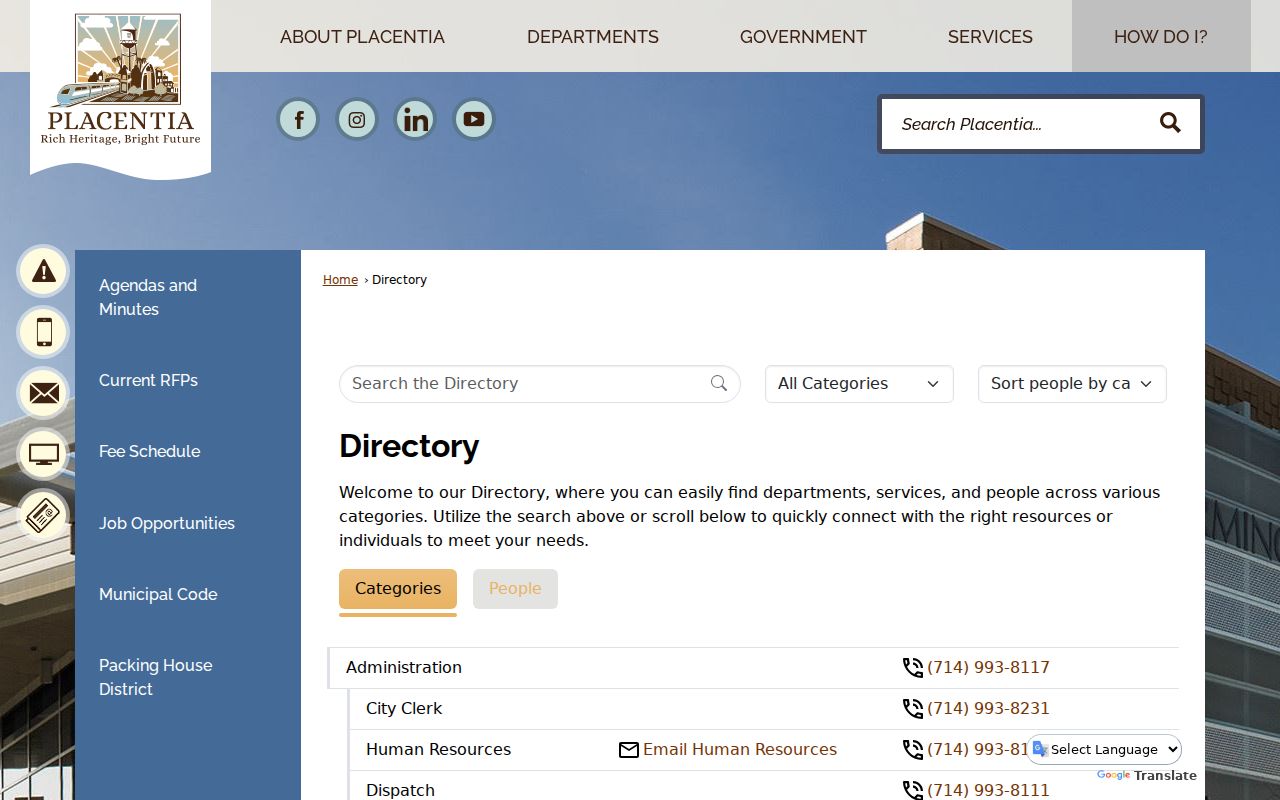
Those category and name controls explain why a municipal contact directory belongs in citations as an office source, never as proof of private residence.
Turn a Placentia Address into an APN
One official bridge turns a Placentia street address into a parcel number. That bridge is the Orange County Treasurer-Tax Collector search. Pick a standardized address from its autocomplete list. A known parcel number works too, if you already have one. Either way, the result hands you the APN. The assessor's secured-value search and RecorderWorks APN mode both require it. That matters for a Placentia residents directory lookup. The free assessor endpoint refuses owner-name queries entirely. Anchoring on the county parcel also protects an address-keyed search from spelling drift.
| Street Address | Autocomplete; select the address from the drop-down before using Find. |
|---|---|
| Parcel Number | Parcel search; examples in the research use an eight-digit number or a decimal unit suffix. |
| Tax Default Number | Tax-default search; the documented pattern is 12-345567. |
| Unsecured search | TC reference, tax year and assessment number, business name, tax lien, watercraft, or aircraft fields. |
One address in Placentia can become an APN in a few steps. If address autocomplete fails, call the Treasurer help line at (714) 834-3411 instead of guessing. The map layer refreshes after the annual roll lands in late July. It then holds still for the whole fiscal year. A recent parcel split may not show up yet. Possessory-interest parcels and some mobile homes can also slip through the search. So treat a miss as a lead rather than a dead end. Before using the tax map layer, accept the OC Tax Map disclaimer. Then compare the parcel geometry against the tax result. That confirms you have the right tract.
This chain of address, APN, parcel geometry, and recorded parties is a solid Placentia residents directory path. It is not proof of occupancy, though. Carry the APN to every custodian you contact. And note the source date beside it each time.
Placentia Resident Records and Owner Names
Orange County's secured-value endpoint stays deliberately narrow. It takes an APN of eight numeric digits. It requires that field. It returns annual-roll value and exemption data while suppressing owner names. In a Placentia residents directory search it is a property-record step, not an owner-name lookup. Once the parcel key is known, move to RecorderWorks for an indexed party.
The county Public Service Counter at 500 S. Main Street, second floor, in Orange is the fresher channel. Counter hours run Monday through Friday, 8 a.m. to 5 p.m. Fees listed: $1 for a roll screen. 15 cents applies per photocopied page. A map costs $1.50. Certification runs $1. A written order can request roll pages or maps. Assessor product questions go to (714) 834-2727. A counter product or a mailing address never confirms a residence.
Practical distinction. An APN identifies the county parcel key; a RecorderWorks party is an indexed record role; neither label alone identifies everyone who occupies the address.
That split is one of Placentia's sharpest records quirks. The free search earns its place in a resident lookup because it confirms the parcel path without posing as a public owner list.
Placentia's Recorded Resident Trail
RecorderWorks holds Orange County's electronic index of recorded documents from January 4, 1982 onward. Tabs include Search By Name, Book and Page, Recording Date, Document Type, Map, Index Books or Fiche Cell, Document Number, Predefined Search, APN, and Legal Description. Dates follow MM/DD/YYYY. Name mode demands a last name; a partial first name helps avoid timeouts.
Property document types span deeds, quitclaim deeds, trust deeds, trustee's deeds, street deeds, easements, reconveyances, parcel and subdivision maps, annexation maps, HOA statements, restrictive covenants, and liens. Read with care. A reconveyance marks a loan payoff, not a new owner, and a substitution of trustee is likewise no purchase. The index shows the reference and indexed parties rather than a free deed image.
A returned row can expose these fields:
- document number, indexed names, and party roles;
- document type, recording date, and older book, page, or instrument references;
- APN and legal-description search paths;
- short description, name combinations, and the copy or cart route.
Documents themselves come from the Santa Ana counter, which handles imaging and certification. Mail is an option once a reference is known. Send a self-addressed stamped envelope and a check payable to Orange County. The phone line at (714) 834-2500 explains procedure. It will not run an open-ended name search. For older records, work the index books or fiche first. Then write Orange County Archives at archives@rec.ocgov.com or call (714) 834-2536 with names, approximate years, a property description, and any book or page reference. The Archives index run covers 1889 through 1953. Its deed volumes run 1889 to 1926. The stretch from 1954 through 1981 still has no confirmed bridge.
Open the RecorderWorks source view to grasp the index-versus-image split before requesting a document.
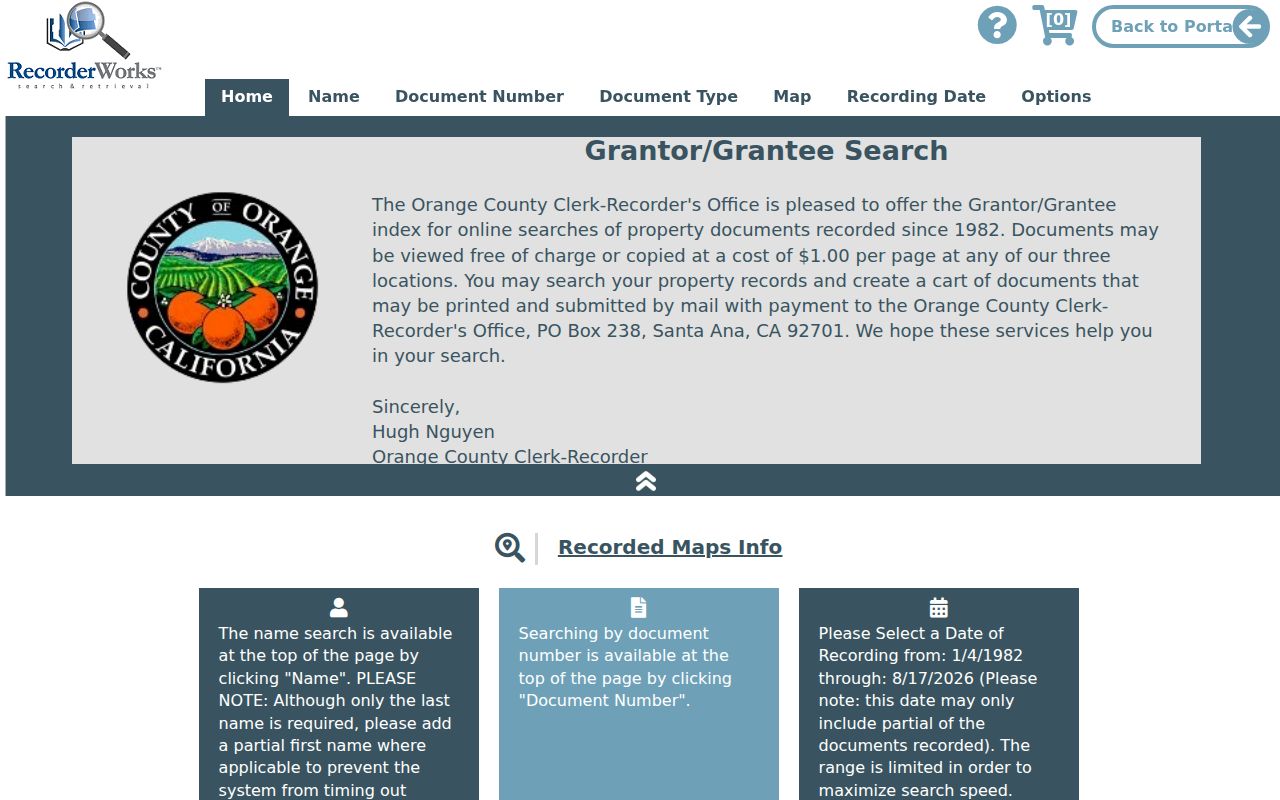
When a deed, legal description, or certified copy is what you need, use the displayed reference to request the actual document.
Placentia Court Records by Name
Placentia court business belongs to Orange County Superior Court. North Justice Center handles most north-county civil and criminal work. Family and juvenile matters go to Lamoreaux as assigned. The county's party-name product needs a free account and paid credits. Its controls cover Person or Business Name and Similar or Exact matching. Also listed are Search Me, Search Criteria, Enroll, Sign In, and Purchase Credits. Search Me is free for the account holder's own registered name.
A name match returns a case number and filing date. The case-number link can open a register of actions where remote access is lawful. The index refreshes daily. It keeps history for 13 months. An identical search reruns free for 14 days. More than 500 matches triggers a choice. Narrow the search, or view the first 500. A common name needs dates, initials, role, and county context. A result is not a certified court record.
Case Access is the known-case-number route. Public terminals and the clerk counter can release documents that remote access withholds. That is especially true in probate, family, civil-harassment, juvenile, adoption, or other protected matters. A mail copy request should name the court, case number, document title, and filing date. Add the copy count and any certification request. Probate search reaches back to 1889. Pre-1985 files generally mean microfiche or reel at Central Justice Center Records and Exhibits.
Open the Orange County case-access source to use the separate known-case-number route.
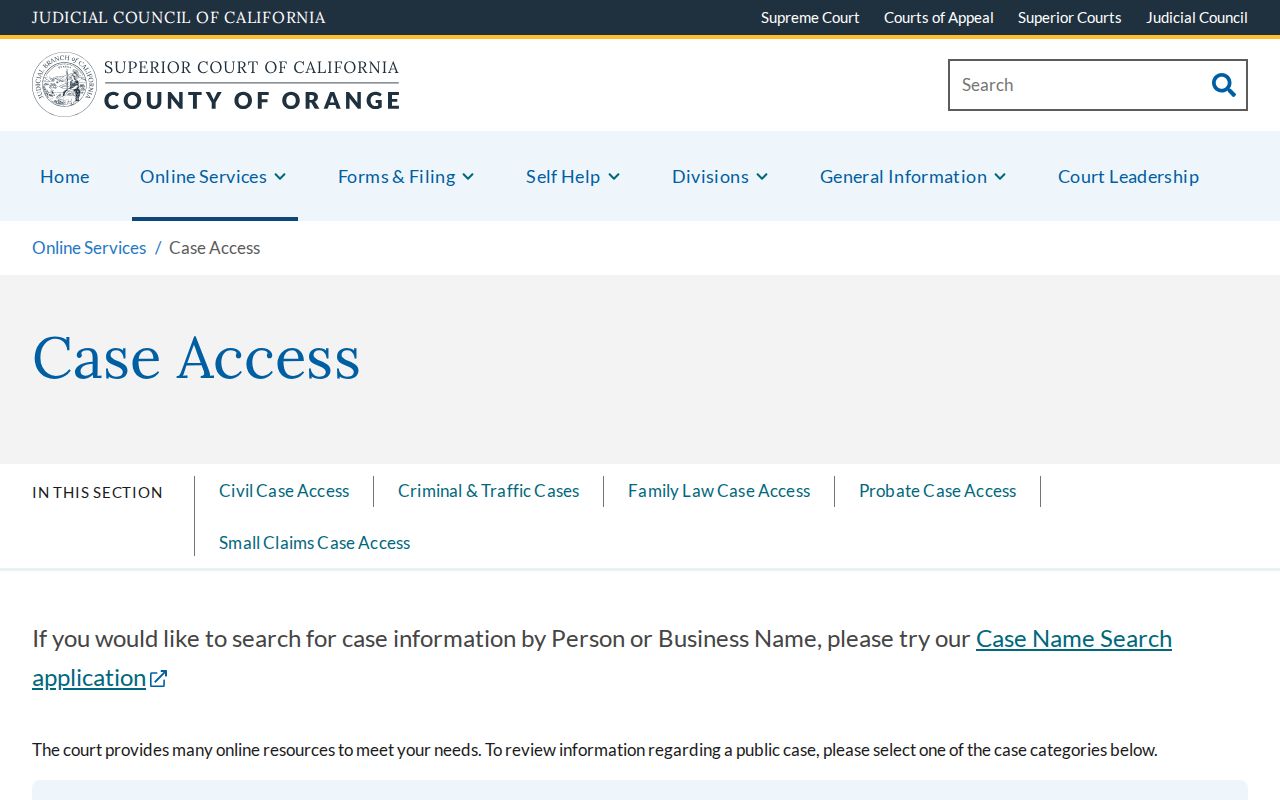
Grab the case number from a name search first. Then hand that number to the clerk when requesting a document.
Placentia Voter Lookup Is Self-Service
The lookup asks for a date of birth first. It also wants the last four digits of a California license or ID number. Sometimes it adds the first three letters of a first name. Those are credentials, not directory terms. Once authenticated, the panels show registration status, name, mailing address, voter status, political party, voter history, districts, elected officials, a sample ballot, and vote-by-mail tracking. This is the voter's own record. It is not an open Placentia residents directory browsable by street or by someone else's name.
Full-file access sits behind Elections Code section 2194 and Government Code section 7924.000. The county application demands an original wet signature, payment, supporting documents, and a lawful approved purpose. Requests travel by mail or delivery to 1300 S. Grand Avenue, Building C, Santa Ana. Mailed orders need photo identification. Buyers can select geography, date ranges, and election-history fields. Signatures, driver numbers, and other protected identifiers stay confidential. Elections Code section 18109 makes misuse a serious boundary.
Aggregate Registrar counts offer a safer civic picture. Registrar aggregates cover city, precinct, and party without naming individual voters. They name no individual neighbor. They also cannot prove every person at an address is registered. Open the Orange County Voter Lookup source to see the authenticated self-lookup form.
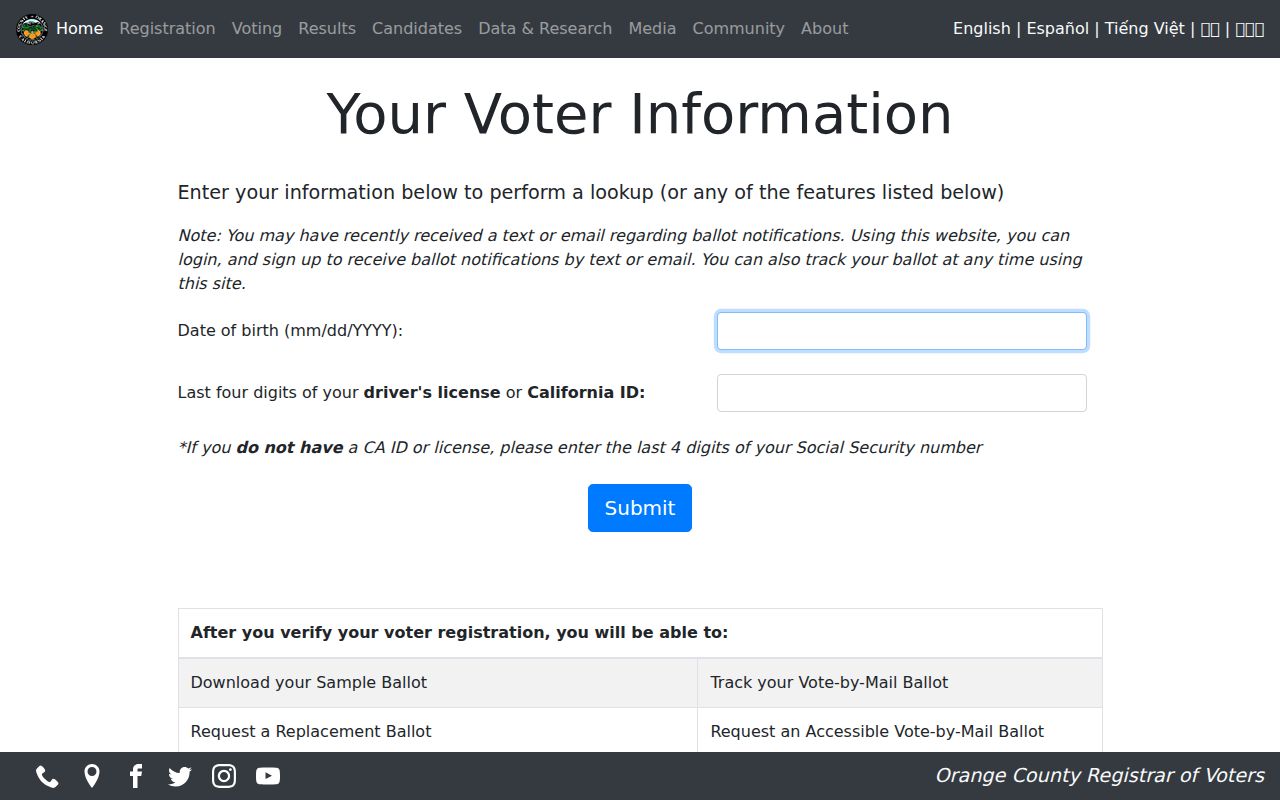
Its own-record credentials rule out any use as a public street list.
Placentia Vital Records for Events
Orange County births, deaths, and public marriages usually start with the Orange County Clerk-Recorder. The California Department of Public Health Vital Records office is the statewide fallback. It suits uncertain counties and state certification. Fees shift, so the 2026 notices control. Orange County lists $34 for birth, $26 for death, and $19 for public marriage. The state lists $31, $26, and $19 for those categories, plus $18 for a dissolution certificate.
Authorized copies go only to statutory relationship classes. Those requesters sign the appropriate sworn statement. Everyone else receives a certified informational copy marked not valid to establish identity. Redactions sometimes apply. The forms are VS 111 for birth, VS 112 for death, VS 113A for marriage, and VS 113B for dissolution. CDPH takes mail with a U.S.-bank check or money order. It will not email or fax certificates. The search fee stays even when no record turns up.
Confidential marriage access is limited by Family Code section 509. Adoption birth records stay sealed under Health and Safety Code section 102705 and Family Code sections 9200-9203. Statewide civil registration begins in July 1905. Earlier Placentia events lean on Orange County Archives, church or parish registers, cemetery material, newspapers, and directory or census pairings. A directory line or obituary helps family research. It is still not a certified civil certificate.
- Roll
- A custodian's assessment record for parcel value or exemptions; it is not a complete list of people at an address.
- Index
- A searchable description of a record, such as an indexed party, date, document type, or APN path, rather than the full image.
- Criss-cross directory
- A historical reverse section arranged by street and number when a verified volume contains one; Placentia's local run remains unconfirmed.
- Parcel
- A mapped property unit identified by an APN. One parcel can contain more than one residence or a common area.
- Informational copy
- A record copy that does not confer the identity-establishing status of an authorized copy.
- Certificate of Record
- The state dissolution index-style record, which is not the divorce judgment or full court file.
- Historical fallback
- Archives, local collections, newspapers, cemeteries, and census pairings used when a civil record predates the available registration channel.
Placentia Permits as Address Evidence
Placentia runs its permitting through SmartGov. The public side offers My Portal, Business Portal, Public Notices, and Parcel Search. Pending applications, issued permits, and parcel context can surface on open pages. Applications and inspection results may sit behind an account. Building and Safety stayed in beta through 2026, and the city cautioned that displayed fees could be wrong around the July 1 fee transition. Older permits missing online? Building and Safety asks researchers to call (714) 993-8124 or use the counter at City Hall.
Depending on the record, a permit names an owner-builder, contractor, applicant, project address, permit type, issue or final date, valuation, and inspection chronology. That is evidence of a project at an address. It is not proof of occupancy, and it is not a complete Placentia residents directory. Legacy cards and files call for a focused California Public Records Act request naming the address, the date span, and separate categories like application, permit, correction, inspection, and certificate or final. Open the Placentia SmartGov source to tell the public parcel and notice modules apart from account-gated application work.
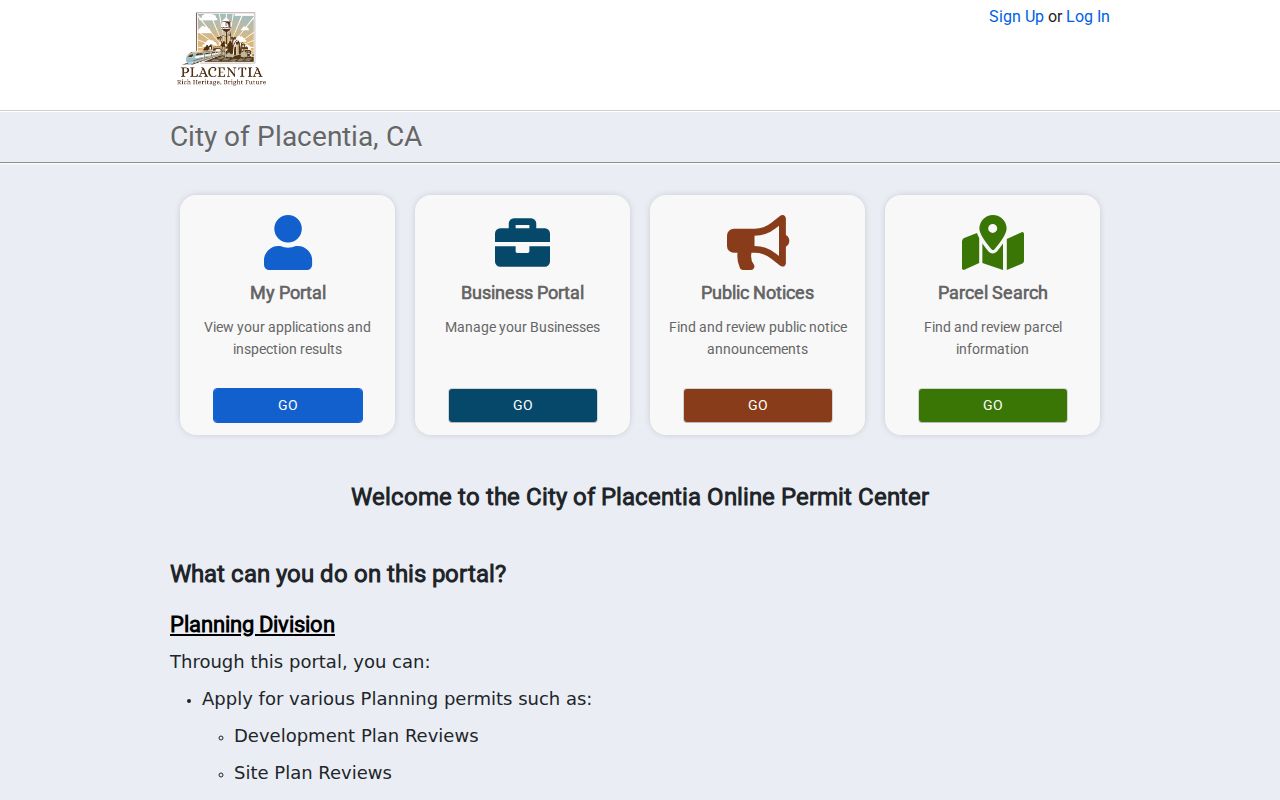
Record which public module produced an address clue. Note whether an account or counter request is still needed.
The City Clerk's legacy request form asks for requester contact information. It also asks for inspection or digital-copy choices. It wants a description of the records wanted, with walk-in, mail, fax, or email intake. The city determines disclosability within ten days. The form lists 60 cents per page, though that legacy rate needs verifying. Before sending anything, the city's Document Portal can be searched by keyword. It can also be browsed by agendas, minutes, ordinances, and resolutions. Open the Placentia Document Portal source as the first browse channel for existing Placentia administrative records.
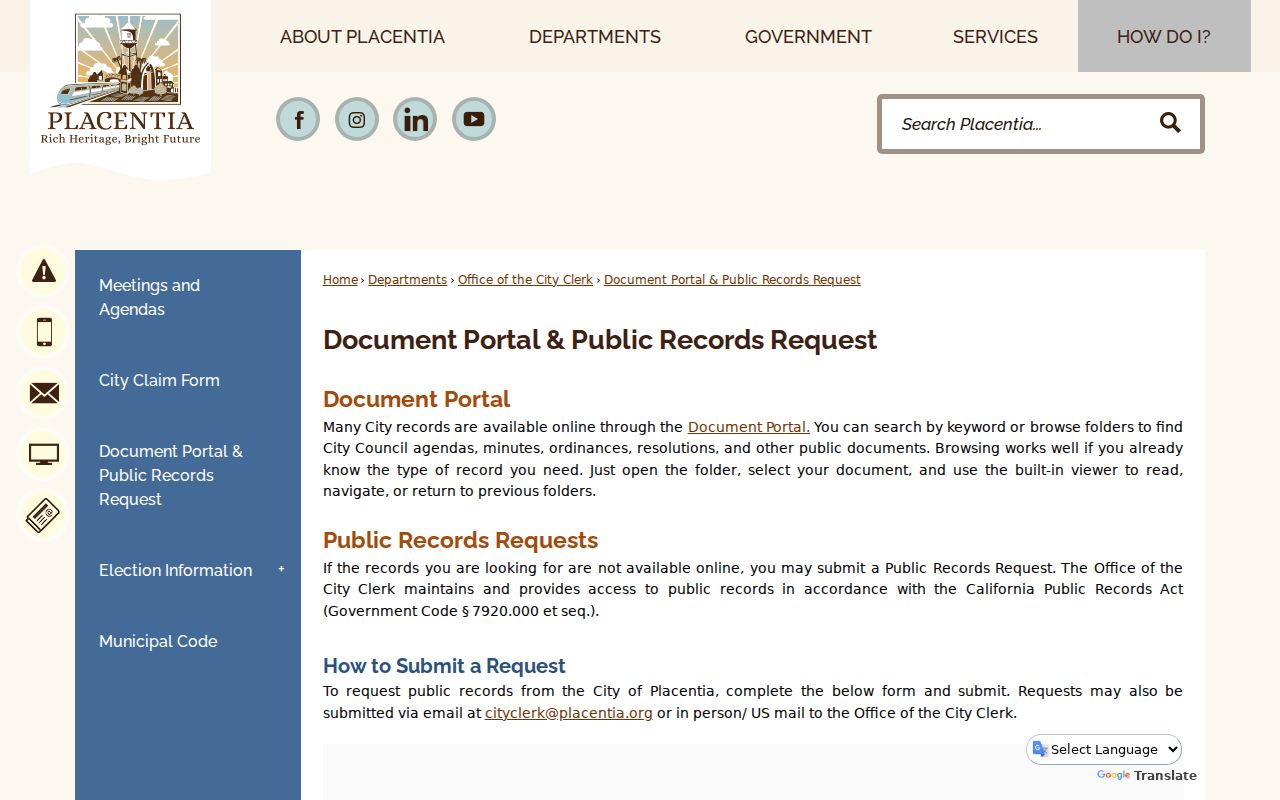
Describe the records you want specifically rather than asking the City Clerk to create a list of residents.
Placentia Residents in History Room Files
The Placentia Library History Room serves as the local historical channel. It holds books, more than 5,000 photographs, videos, oral histories, maps, and past PYLUSD high-school yearbooks. Named manuscript collections include Ziegler, MacFadden, Gerhold, Richards, Lyons, Carpenter, Higuera, and Kraemer family papers. Citrus-packing, hospital, PTA, women's, and civic-organization records round out the shelves. These holdings can place a directory name in a family or community context. They do not pretend to be a current household register.
General local-history material is open during library hours. Special manuscripts and ephemera need an appointment. A strong request lists surnames, aliases, organization, approximate dates, and a street or APN when known. Reach the History Room at (714) 528-1906 extension 224 or historyroom@placentialibrary.org. The library also runs a Memory Lab. It is a three-hour do-it-yourself preservation service. It requires a library card, an agreement, orientation, and suitable storage.
Tracing a former Placentia resident? Ask staff for the shelf inventory of city and county directories. The shelves also hold telephone books, reverse or criss-cross books, newspapers, obituary indexes, and yearbooks. The library publishes no exact runs. So the staff response becomes part of the source record.
Placentia Resident Clues in Business Filings
Business filings can corroborate a name. They cannot turn a filed office address into a claimed residence. California Secretary of State bizfile accepts an entity name or file number. Advanced search adds entity group or type, status, and an initial filing-date range. A detail page can show the entity number and name, formation date, status and standing, and jurisdiction. It also lists principal or mailing address, agent for service, statement due date, filing history, and free filing PDFs. The Secretary of State keeps no conclusive beneficial-owner field.
Orange County fictitious-business-name filings tie a trade name to registrants. They include the registrants' filed business or mailing addresses. Check the county FBN channel and the city's business-license or public-record route. Also try the relevant California Department of Consumer Affairs license board. DCA search fields cover board or bureau, license type, license number, and business or personal name. Keep roles straight. A license address, agent address, principal office, and court-party address all mean different things.
These sources help resolve variant spellings. They can separate an entity from a natural person and identify the right custodian. For a question about a current person, confirm role and date with a second independent record. A filing alone is not a complete Placentia residents directory entry. But it strengthens a resident lookup.
When Placentia Resident Records Stop
An official trail can end for good reasons. Deed and property records center on title parties and legal descriptions, not every household member. Voter rolls stay restricted. Confidential and protected voters are omitted. DMV data and utility customer files are closed channels. Court displays online can be narrower than a courthouse terminal, and adoption, juvenile, sealed, confidential family, and protected personal records may never appear online at all.
California privacy law also separates an official record from a commercial compiled copy. The California Consumer Privacy Act and the California Privacy Rights Act grant rights to know, delete, correct, opt out of sale or sharing, and limit sensitive-information use, subject to exceptions. The statewide DROP platform opened January 1, 2026. Registered brokers begin processing requests August 1, 2026. Deleting a broker entry never deletes the deed, case, or certificate its custodian holds.
Qualifying survivors and threatened workers can use California Safe at Home, Government Code sections 6205-6216, for a substitute mailing address and confidential voter procedures. It does not automatically remove already-public property material. So the shield has limits. When the trail stops, contact the custodian or narrow the request to an existing record. Preserve the uncertainty rather than filling the gap with a guessed identity.
| Source type | Useful for | Limit to keep visible |
|---|---|---|
| Official county or city record | A dated, custodian-held fact | Scope, access rule, and record role still apply |
| Historical collection | Family, address, school, or community context | May cover only a year or an unlisted collection |
| Commercial compiled search | A lead for a lawful personal check | May be stale, merged, or drawn from different address roles |
Lawful personal use. Use Placentia records for a legitimate personal, family-history, civic, or records request purpose. Do not use an address, voter record, court entry, or directory clue to stalk, harass, threaten, or harm a person.
Historical Placentia Directory Years
The Orange County directory bridge is narrow but real. The National Archives inventory includes Placentia in regional directories for 1926, 1929, and 1931, and lists Atwood separately. Placentia incorporated in 1926. The first directory year and the city's civic beginning sit close together. The NARA page names no publisher. No openly inspectable Placentia sample entry exists.
Search the Placentia and Atwood headings, then pair a directory name and address with the 1930 federal census, newspapers, yearbooks, deeds, photographs, manuscripts, or oral histories. A directory reflects publisher canvassing at one moment. A census reflects an enumeration date. Neither proves continuous residence. The full shelf, access channels, abbreviation keys, and year-by-year tracing method appear in the Placentia city directory collections treatment.
These years close the home-page path from current records to historical households while leaving the gap around publisher, shelf, and reverse-directory details.