
Placentia Resident Lookup Records at a Glance
Think of a Placentia resident lookup as several distinct record questions rather than one search. The Orange County RecorderWorks index ties an indexed party to a recorded document. It also returns an APN. The secured-value search takes an eight-digit APN and keeps owner names off the public screen. To bridge an address to a parcel number, use the Treasurer tax search. Courts, vital records, voter rolls, and license boards each answer something different. Treat no single result as a complete resident record.
| Record | What It Confirms | Where to Search | Access |
|---|---|---|---|
| Recorded deed index | Indexed parties, document type, dates, and chronology | RecorderWorks | Free index; copies are paid |
| Parcel and tax record | APN, parcel value, and exemptions | Assessor and Treasurer | APN required; owner name suppressed online |
| Court record | Party role, case number, filing date, status, and docket entries | Orange County court search | Account and credits, known-number access, or counter |
| Vital record | Birth, death, marriage, or dissolution evidence | County Clerk-Recorder or CDPH | Authorized or informational copy rules |
| Voter self-record | Registration status, address, party, history, and districts | OC Voter Lookup | Authenticated self-service |
| Business or license filing | Filed roles, entity details, license status, or discipline | bizfile and DCA | Public search with role limits |
Lead with your strongest fact. An address points to an APN. A case number points to a docket, a family event to a certificate request, and a professional name to a state board. A common surname is the hard case. Start with spelling variants and a rough time or place, then work toward a supported match rather than the biggest pile of hits.
Placentia Court Name Search
State court matters for Placentia sit in the Orange County Superior Court system. The Case Name Search takes a Person or Business Name. It offers Similar, the default, or Exact matching. Case type can be set to All or Criminal. There is also a Search Me option. It checks the signed-in account name without a paid third-party query. Name searching requires a free account plus paid credits. A known case number opens a separate door through the court's Case Access service.
One credit costs $1.50. Packs run $5 for five. They also run $9 for ten, $70 for 75, or $400 for unlimited searches across 30 days. Rerunning an identical search is free for 14 days. Transaction history stays available for 13 months. If a query returns more than 500 matches, you must narrow it or view just the first 500. Even a "Record Not Found" result spends a credit. Results refresh daily, with routine overnight and evening maintenance windows.
For a Placentia resident lookup, the court party-name screen is a natural index entry point. The Orange County party-name search page shows where a person or business query begins.
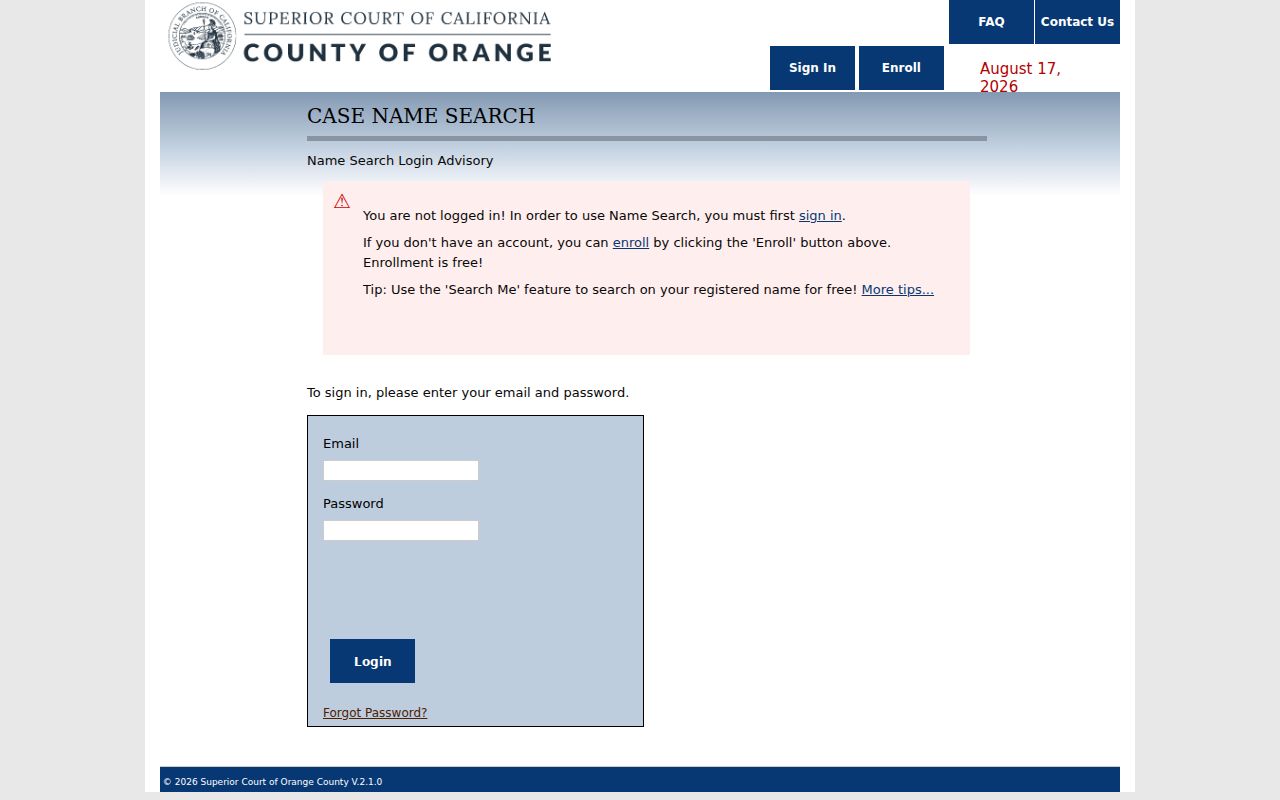
A returned case number and filing date give you firm anchors. From there, look only at register entries and document links that remote access actually permits. Remember that a web result is never a certified record. Party roles vary widely too, spanning plaintiff, defendant, petitioner, respondent, decedent, and personal representative. The court's published name-search rules and fees draw the access line plainly. Treat any fee or result-behavior display as a reference point. It is not a stand-in for the clerk's file.
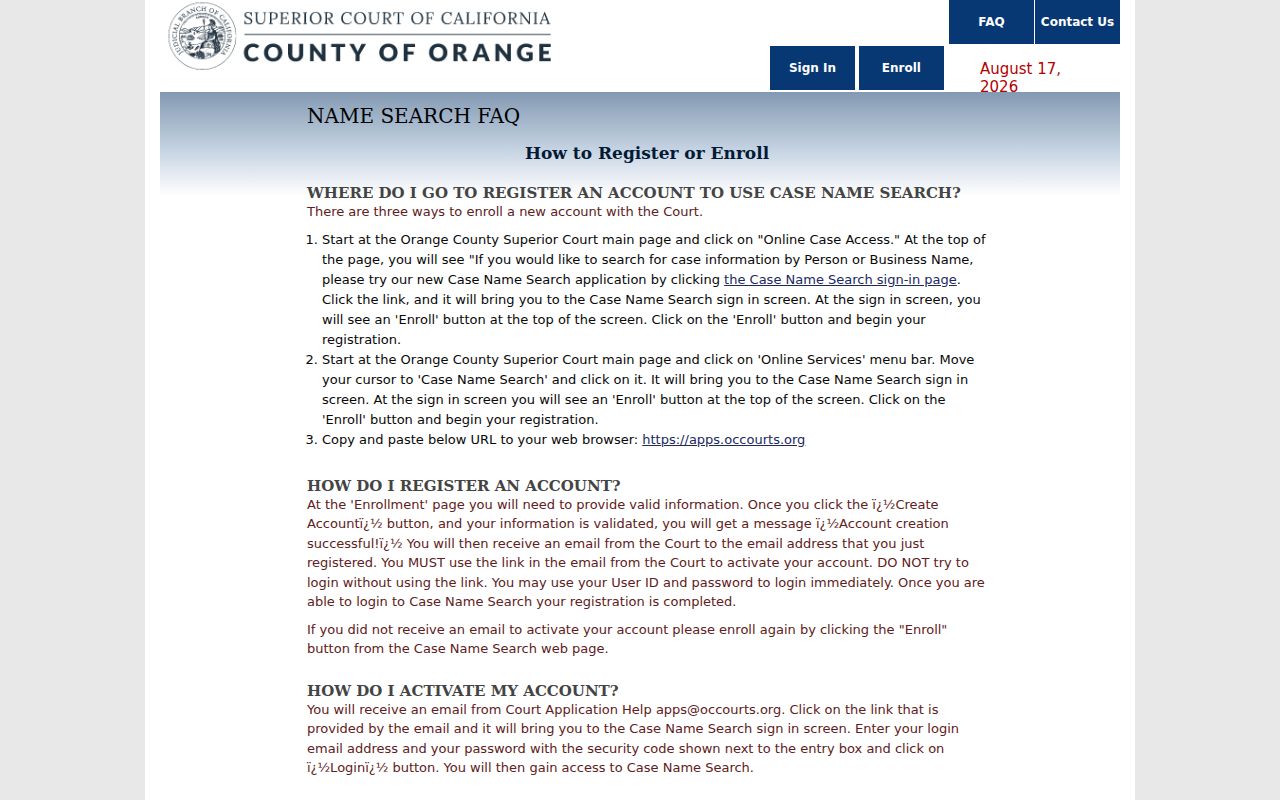
Not everything reaches the web. Family, juvenile, adoption, paternity, sealed, and confidential matters may be missing from remote display entirely. Probate, family, and civil-harassment documents often demand a public terminal. Some demand a trip to the clerk's counter. Others need a copy order. Venue splits by case type: North Justice Center carries much of the north-county civil and criminal load, while family and juvenile matters route to Lamoreaux as assigned.
Federal cases live elsewhere. Search PACER separately for any federal lead. Through December 31, 2026, access runs 10 cents per page. Charges are generally capped at $3 per document. Quarterly charges of $30 or less are waived. The announced January 1, 2027 rate is 12 cents per page. It comes with a $40 quarterly waiver. A state case number means nothing in the federal system.
Verify a Placentia Resident's Identity
A name alone proves little. It becomes useful once a second record adds a discriminating fact, such as an APN, a legal description, a filing address, a spouse or relative, a license number, or a court location paired with a date. Label every address by its role: mailing, agent, business, case-party, or property. An owner, agent, or party is not an occupant, so never assume one.
- Normalize the given name, surname, initials, compound forms, and likely spelling variants. Write down the query date and the source’s stated coverage.
- Anchor the name to an address or parcel when one is known. Convert an address through the Treasurer to an APN, then use the APN in RecorderWorks.
- Run the Orange County party search with Similar for discovery or Exact for a controlled check. Save the case number and filing date before reading the result.
- Compare a second independent record, such as a vital index, business filing, professional license, probate case, or historical directory entry.
- Order a certified copy from the custodian only when the document, eligibility, and purpose are clear. A phone call can confirm procedure, but the custodian issues the record.
- Docket
- The court’s running case record, showing filings, events, and status entries rather than every document in full.
- Index versus image
- An index is a searchable description of a record. An image is the document itself, and access or copy fees may differ.
- Certified copy
- A copy formally attested by the custodian. Certification supports proof of the document, not proof that every name match is the same person.
Sometimes the question widens from one person to an entire road. Then the address-focused Placentia street directory is the right switch. A resident lookup verifies a single candidate, while a street search organizes parcels and recorded parties along the whole block.
Vital Records for a Placentia Resident Lookup
Vital records anchor many a Placentia resident lookup. Births, deaths, and marriages recorded in Orange County run through the County Clerk-Recorder, which takes requests at its counter and by mail. For events where the county is uncertain, or when a statewide certification is needed, the statewide California Department of Public Health Vital Records office is the fallback. No simple age rule applies in California. Ordinary certificates stay restricted rather than fully open. Authorized copies go only to requesters in defined statutory relationships, and nearly everyone else receives a copy marked informational.
| Record | Custodian and access rule | 2026 fee |
|---|---|---|
| Birth | Orange County or CDPH; authorized or informational copy | County $34; state $31 |
| Death | Orange County or CDPH; eligibility and copy type apply | $26 |
| Public marriage | Orange County or CDPH; authorized or informational copy | $19 |
| Confidential marriage | County of license; spouses or court order under Family Code section 509 | $19 base where issuable |
| Dissolution record | CDPH certificate of record is not the Orange County decree | CDPH $18 |
State forms carry their own numbers: VS 111 for birth, VS 112 for death, VS 113A for marriage, and VS 113B for dissolution. Each form records the event date and place. The names involved, parents or spouses where they apply, and the requester's relationship are also recorded. Mailing details, a signature, and the authorized-versus-informational choice complete it. Authorized copies sent by mail must be notarized. CDPH takes a check or money order drawn on a U.S. bank only. No certificates go out by email or fax. The search fee is kept even when no record exists. The office then issues a Certificate of No Public Record.
At the county level, the Clerk-Recorder sets the current instructions for in-person or mail service. Statewide registration generally began in July 1905. For events predating it, other channels fill the gap. The Orange County Archives, church or parish material, cemetery and interment records, newspapers, and census pairings with a city directory all serve as historical fallbacks. A directory line or an obituary can strengthen a family-history lead. It still cannot replace a certified civil record. For divorce, find the Orange County case itself when a judgment is required. The CDPH certificate is index-style evidence only.
Placentia Business and License Records
A business filing can help tell two Placentia residents apart when they share a name. It is not proof of where someone lives, though. California's bizfile portal takes an entity name or a file number. Advanced Search narrows things further by entity group, entity type, status, and an initial filing-date range.
Open a detail record and the filing shows real substance. Entity number, formation date, status, and jurisdiction all appear, along with standing. So do the principal and mailing addresses, the agent for service, and the Statement of Information due date. Filing history and free PDFs of the filings sit in the same record. Two limits matter. A keyword search returns only the 500 closest matches, and no conclusive beneficial-owner field exists anywhere in the file. An Orange County fictitious-business-name filing or a city license record adds a useful second layer to a Placentia resident lookup, and the California bizfile business search supplies the entity controls for that work.
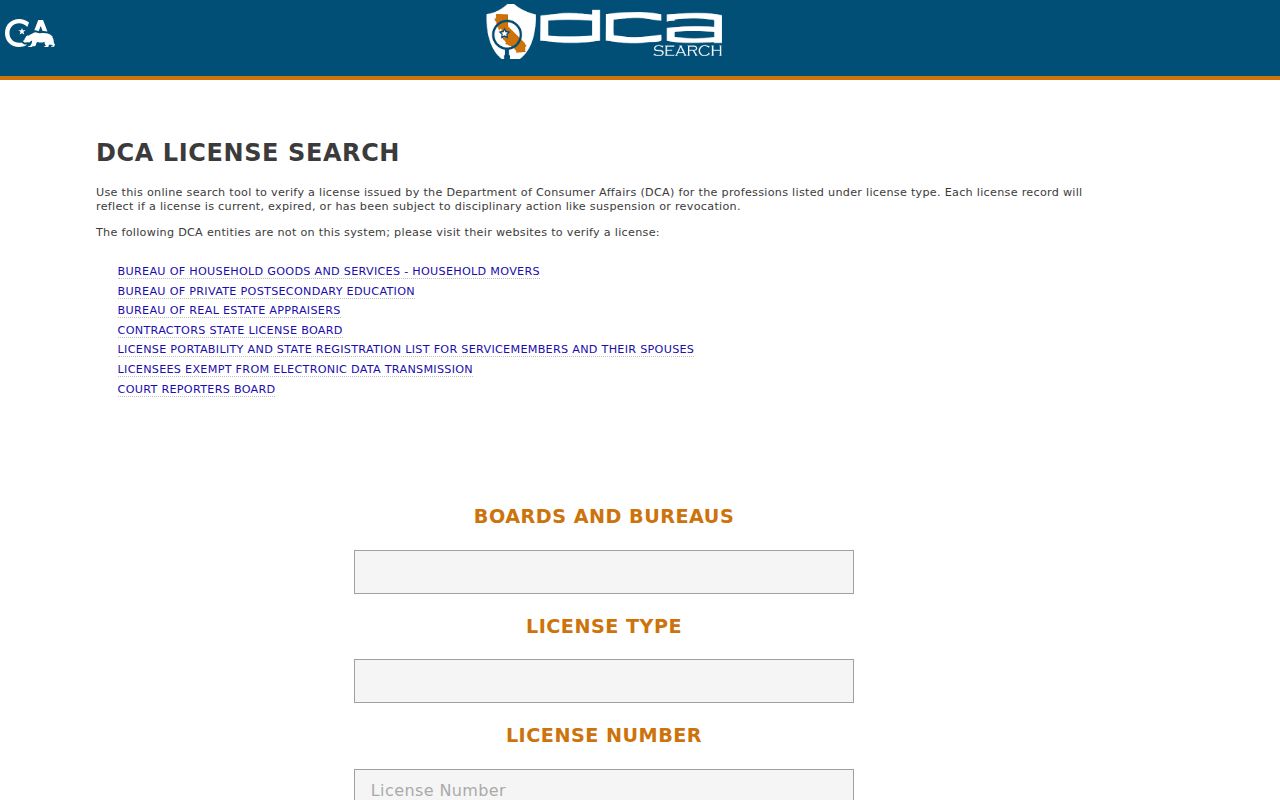
A state entity record is only half the picture. Pair it with an Orange County fictitious-business-name filing. Add a Placentia city record or a license board too. The California Department of Consumer Affairs license search offers the strongest credential check. A searcher can pick a board or bureau first. Then narrow by license type or number. Business name and personal name both work as queries too. Results may include the license number. They may also show its status, issue and expiration dates, and any public discipline. The DCA License Search is the source for that verification layer.
Fictitious-business-name filings give Orange County a local channel. The Clerk-Recorder FBN service ties a trade name to its registrants. It also lists their filed business or mailing addresses. Posted fees include $23 to search one name or registrant. Each addition costs $7, and a certified copy is $2. Even so, a filing is not proof of current residence. Placentia publishes no browsable public register of local licenses. Ask the Placentia City Clerk for one specific, identifiable record. Request that rather than a compiled resident list. Unclaimed property adds another clue. The free California unclaimed-property search can surface a reported owner, city, holder, property ID, type, and value band. Claiming anything requires proof of identity or ownership.
An Official Placentia Birth-Parent Path
Birth-parent searches carry a strict legal boundary. California seals original birth and adoption files. The authority is Health and Safety Code section 102705 and Family Code sections 9200 to 9203. No informational birth copy can open them. A public residents directory cannot either. The lawful path runs through the statutory court, the California Department of Social Services, or CDPH. It also includes any official mutual-consent or intermediary option open to the parties involved.
The current adoption-reunion application form and program details were not fully inventoried here. Verify the form, eligibility, identity proof, and delivery channel with the responsible state or court office. Do this before sending anything sensitive. A resident lookup can point you to the right custodian. It can also organize what you already know. It cannot bypass a seal.
Placentia Voter Lookup Is Self-Service
The Orange County Voter Lookup is built for the voter alone. It asks for date of birth. It also takes the last four digits of a California license or identification number, or an SSN where applicable, then the first three letters of the first name if more proof is needed. Once authenticated, a voter can view registration status, name, mailing address, voter status, political party, voter history, districts, elected officials, a sample ballot, and vote-by-mail tracking. It is not a reverse-name or address directory. It never opens one voter's file to another.
Full-file requests run through a different channel. Orange County requires an original wet signature, payment, supporting documents, and a lawful approved purpose. Mail or delivery goes to 1300 S. Grand Avenue, Building C, Santa Ana, 92705, and mail orders must include photo ID. Email and fax applications are not accepted. An application can narrow the request to a district. It can also cover a registration date range, none, all, or selected voter history, and selected elections. State pricing is $15 per 1,000 records with a $100 cap, while county product fees differ. Registrar questions go to (714) 567-7600.
The legal footing matters here. California Elections Code section 2194 and Government Code section 7924.000 restrict full-file access to approved uses. Those uses cover election, scholarly, journalistic, political, or governmental purposes. Driver or identification numbers, signatures, unique identifiers, and other protected fields stay confidential. Voter participation never reveals ballot choices. For most questions, current county, city, and district counts are safer aggregate context. They beat a named list.
Placentia Heir and Classmate Leads
Probate is the right official route after a death. Use it when the question concerns an estate or heir. Orange County probate searches reach back to 1889. Older files usually move to microfiche or reel at the Central Justice Center Records and Exhibits counter. An online index can find the case. The documents come from the terminal or the counter, since remote rules withhold them. Mail copy requests use Form L-3009. Name the case, the decedent, the document, the date if known, the copy count, and any certification request. The court charges 50 cents per page plus certification.
A former classmate takes a different lead. Ask the Placentia Library History Room for the exact PYLUSD school, the yearbook, and the years it holds. The historical collection also includes books, photographs, videos, oral histories, maps, and family or civic manuscripts viewable by appointment. Staff confirmation is part of the search. A yearbook proves school ties in one year, and a probate address records a filing-time fact, not a present contact.
Directory years and reading methods belong with the Placentia city directory collections. Borrow only what separates one candidate. A one-person lookup needs only distinguishing evidence.
What an Orange County Resident Lookup Result Shows
Note which fields appeared. Note which ones did not. A court index, a business filing, a license record, and an unclaimed-property result each use different labels and address roles. The inventory below describes the public fields documented for the main Placentia resident lookup routes.
- Court search: indexed party name, case number, filing date, category or type, status, court location, allowed party roles, events, register of actions, and remotely releasable civil-document links.
- Criminal-side court display, where visible: OC Pay number, defendant, status, hearings, release or sentencing, related cases, and warrant number.
- bizfile: entity name and number, formation, status, standing, jurisdiction, principal or mailing address, agent, due date, filing history, and PDFs.
- DCA: board or bureau, license type and number, status, issue or expiration date, and public discipline link.
- Unclaimed property: reported owner, reported city or address, property ID or type, holder, and value category.
Label every address by its role. A principal office, a mailing address, an agent address, a license address, a court-party address, and a reported property address can point to different places and dates. A “no result” means no result in the named portal under the recorded query and coverage. It is not proof that no record exists.
Privacy Choices Around Placentia Resident Records
California's CCPA and CPRA grant qualifying people real rights. Civil Code section 1798.100 and following governs. Those rights include knowing, deleting, correcting, opting out of sale or sharing, using Global Privacy Control, limiting sensitive-information use, and receiving notice, subject to exceptions. Deleting a commercial copy erases no official deed or court file, and government-public information may fall outside a deletion request.
California DROP opened January 1, 2026. Registered data brokers are scheduled to begin processing requests August 1, 2026. For another commercial record, send only the minimum matching details. Verify the requester process, save the confirmation, and check again later. The California DROP platform is the official start.
Safe at Home gives qualifying survivors and threatened workers a substitute address, mail forwarding, and confidential voter procedures. It does not remove already public material. It does not conceal a property record. Recorder Social Security number redaction follows Government Code sections 27300 to 27307, while the original record remains preserved. Correct errors with the custodian of the source record, not a downstream compiler.
The California DOJ Megan's Law registry requires disclaimer acceptance. Its data may change or be incomplete. Its result is a statutory registry record, not a general resident match.
The registry's official page posts the separate warning and search boundary a Placentia resident lookup meets in this record category.
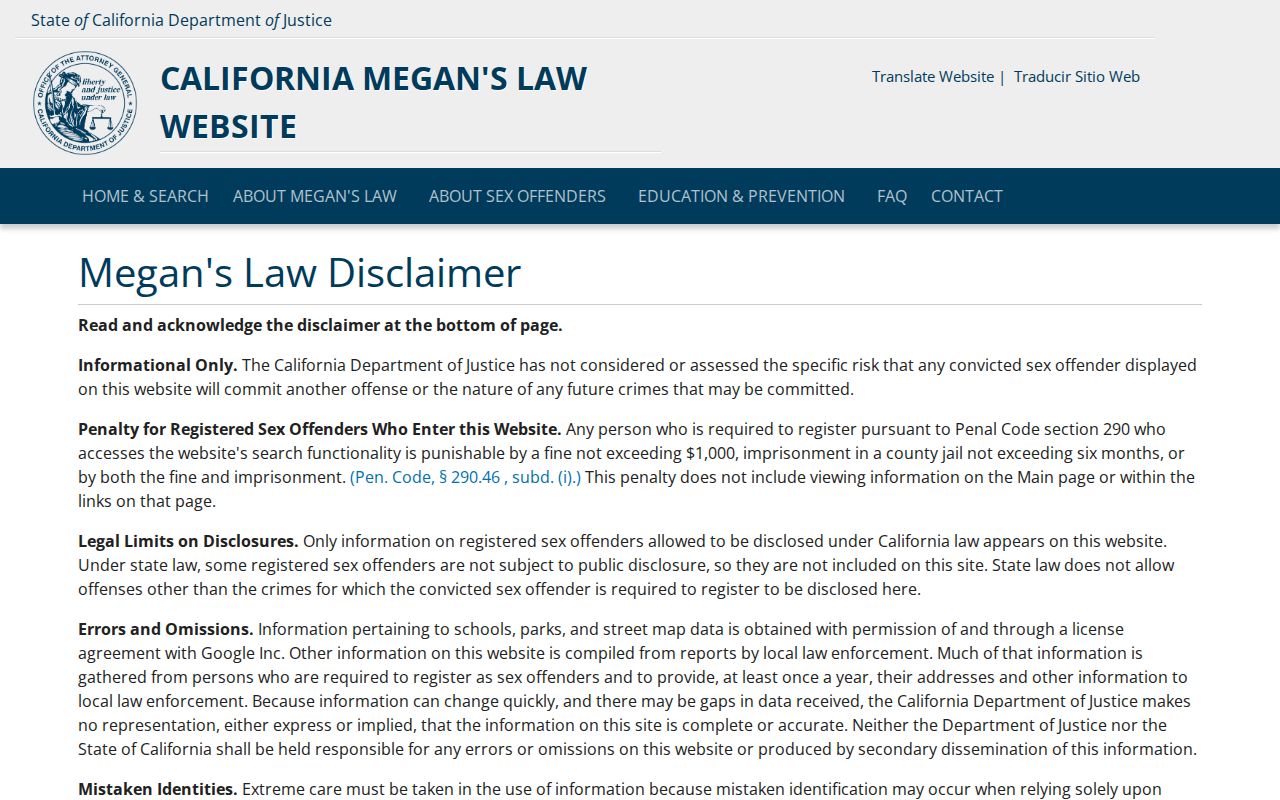
Never identify a person from a name, an age, or an address alone. Penal Code section 290.46(j) imposes consequences for anyone who uses registry information for criminal or harassing purposes.
Legal Boundaries for a Placentia Resident Lookup
A Placentia resident lookup serves real purposes: family history, reconnecting, records verification, estate research, civic curiosity. What it does not do is grant permission. A public index cannot be turned into a warrant to approach a private address, infer a protected identity, or stitch separate records into a dossier. Penal Code section 646.9 addresses stalking. Code of Civil Procedure section 527.6 addresses civil harassment. Voter misuse can trigger Elections Code section 18109. Megan's Law carries its own statutory warning and its own consequences for misuse.
Lawful use. Use resident records for personal, lawful research and verify important facts with the custodian. Never use a name, address, court entry, voter record, or registry result to stalk, harass, intimidate, or harm anyone.
When a result is uncertain, stop. Ask the responsible office about a lawful copy or correction route. Keep it narrow, dated, and supported by independent facts.